CIA Officer Colbert looks up from the file. "Dammed! Is it possible that the Soviets found some secret German technology during the war?"
The Cold War
The Cold War was not a traditional military conflict of clashing frontlines, but an all-encompassing ideological, technological, and geopolitical standoff. For over four decades, the United States and the Soviet Union sliced the world into spheres of influence.
The foundations of this decades-long struggle were laid in the chaotic, closing months of World War II, where a desperate race for absolute military dominance permanently shattered the wartime alliance between Washington and Moscow.
1. The Atomic Genesis (1942–1945)
The shift from partners to rivals began in total secrecy. As American, British, and Soviet soldiers fought to defeat Nazi Germany, the United States was quietly spearheading the Manhattan Project—a massive, top-secret scientific and military initiative aimed at developing the world’s first nuclear weapons.
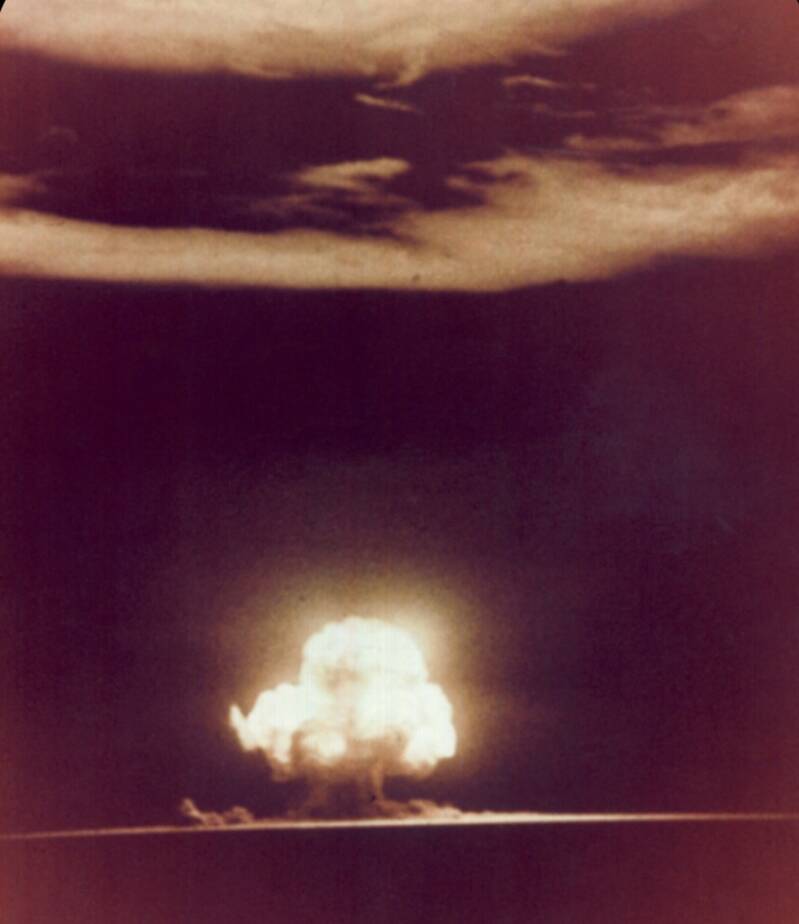
While Soviet Premier Joseph Stalin was kept entirely in the dark by official channels, his sprawling intelligence network had already deeply penetrated the project. By the time the U.S. successfully conducted the Trinity test in July 1945, the geopolitical chess board had fundamentally shifted.
The Potsdam Divide
In late July 1945, the "Big Three" allied leaders met at the Potsdam Conference just outside a defeated Berlin to outline the postwar order. The atmosphere was vastly different from previous wartime summits. President Harry S. Truman, newly elevated to office after FDR's death, received word during the conference that the atomic bomb was functional.
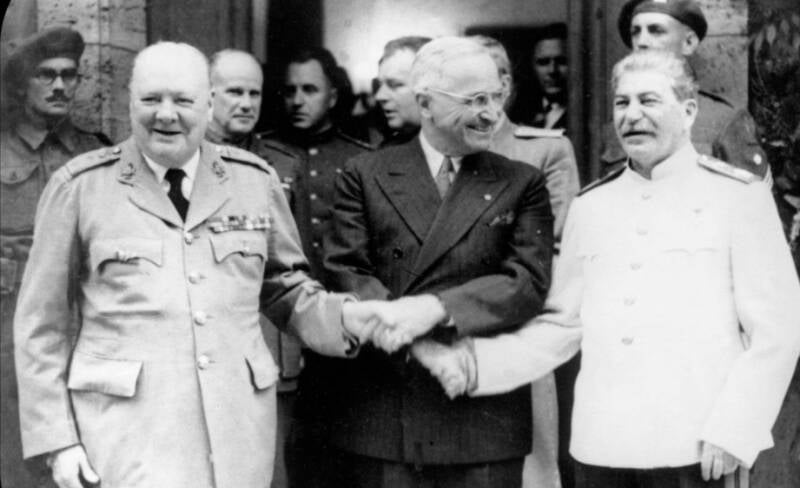
When Truman casually mentioned to Stalin that the U.S. possessed a "new weapon of unusual destructive force," Stalin merely nodded, calmly noting he hoped the U.S. would make "good use of it against the Japanese." Stalin’s calm demeanor masked the fact that his spies had been delivering precise blueprints of the American bomb to Moscow for months. Potsdam ended without a true consensus, revealing the deep cracks that would soon split Europe into Western and Soviet blocs.
The End of World War II
The endgame of the war in the Pacific served as both the final act of World War II and the opening salvo of the Cold War:
August 6 & 9, 1945: The United States dropped atomic bombs on Hiroshima and Nagasaki. The unprecedented devastation forced Japan’s unconditional surrender, ending World War II without the need for a bloody, protracted Allied amphibious invasion of the Japanese mainland.
August 9, 1945: Simultaneously, fulfilling a promise made months earlier at the Yalta Conference, the Soviet Union launched a massive, lightning-fast invasion of Manchuria, obliterating Japan's Kwantung Army in days.
The dual shocks of atomic devastation and the overwhelming Soviet advance across Asia left a profound impression on both sides. To Moscow, the deployment of the atomic bomb was seen as a direct display of American muscle intended to keep Soviet ambitions in check.
2. Secrets, Spies, and the Broken Monopoly (1945–1949)
American military planners initially calculated that it would take the Soviet Union a decade or more to develop its own nuclear capabilities. This calculation was completely upended by internal betrayal.
Klaus Fuchs and Atomic Espionage
Among the foreign scientists working on the Manhattan Project was Klaus Fuchs, a brilliant German-born physicist and convinced communist who had fled to Britain. Fuchs worked at the Los Alamos laboratory, the heart of the American nuclear program.
Throughout his time there, Fuchs systematically passed highly detailed technical data—including crucial schematics for the "Fat Man" plutonium implosion bomb—to Soviet couriers. His treason effectively handed Moscow the keys to the nuclear age, cutting years off their research timeline.
First Soviet Nuclear Test (1949)
Armed with Fuchs’ stolen data and led by physicist Igor Kurchatov, the USSR shocked the world on August 29, 1949, by successfully detonating its first atomic device, codenamed RDS-1 (known to the West as "Joe-1").
The sudden loss of the American nuclear monopoly sent shockwaves through Washington. The realization that the Soviets now possessed the bomb triggered a Red Scare inside the U.S., sparked a desperate American crash program to build the even more destructive Hydrogen bomb, and locked both superpowers into an escalating nuclear arms race.
3. The Cold War Turns Hot: The Korean War (1950–1953)
By 1950, the friction point of the Cold War shifted violently to East Asia. Following WWII, the Korean Peninsula had been divided along the 38th Parallel into a communist North (backed by the USSR) and a capitalist South (backed by the U.S.).
On June 25, 1950, North Korean forces launched a sudden, massive invasion across the border to unify the peninsula by force. Truman viewed this as a direct act of Soviet-directed communist aggression and successfully rallied the United Nations to authorize a military intervention.
By 1953, the conflict ground to a bloody, exhausting stalemate near the original border. An armistice was signed in July 1953, establishing a heavily fortified Demilitarized Zone (DMZ). The Korean War proved that the Cold War would not just be fought with words and espionage—it would involve devastating proxy wars that cost millions of lives.
4. The High Frontier:
The Space Race Begins (1957–1966)
As the 1950s progressed, the superpower competition expanded beyond terrestrial borders and vaulted into the cosmos. What became known as the Space Race was never just about scientific discovery; it was a critical, high-stakes public relations campaign to prove which ideological system possessed superior technological power. Crucially, the very same rockets used to launch satellites into orbit could also carry nuclear warheads across continents.
The Sputnik Shock
On October 4, 1957, the Soviet Union stunned the world by launching Sputnik 1, the first artificial satellite, into Earth orbit.
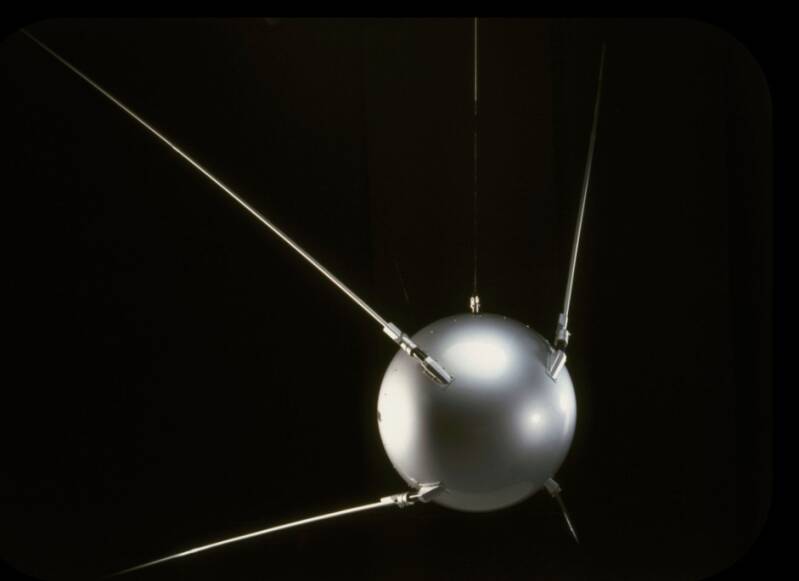
To the American public, the steady, rhythmic beep-beep transmitted by Sputnik as it passed overhead was a terrifying reminder that the Soviet Union had beaten them into space. The "Sputnik Shock" triggered widespread fear that the U.S. was falling behind scientifically, prompting the creation of NASA and a massive infusion of government funding into science and engineering education.
The Early Soviet Lead
For several years, the Soviet space program, masterminded by Chief Designer Sergei Korolev, racked up an unbroken string of historic firsts:
First animal in orbit (the dog Laika aboard Sputnik 2)
First human in space (Yuri Gagarin aboard Vostok 1 in April 1961)
First woman in space (Valentina Tereshkova in 1963)
First multi-person crew and first spacewalk (Alexei Leonov in 1965)
The American Response: Project Gemini (1961–1966)
In response to Gagarin’s flight, President John F. Kennedy boldly committed the United States to landing a man on the moon before the decade was out. Achieving this meant moving past the basic, single-pilot Mercury flights and learning the actual mechanics of spaceflight.
This bridge to the moon was Project Gemini, a two-man spacecraft program that dominated the mid-1960s.
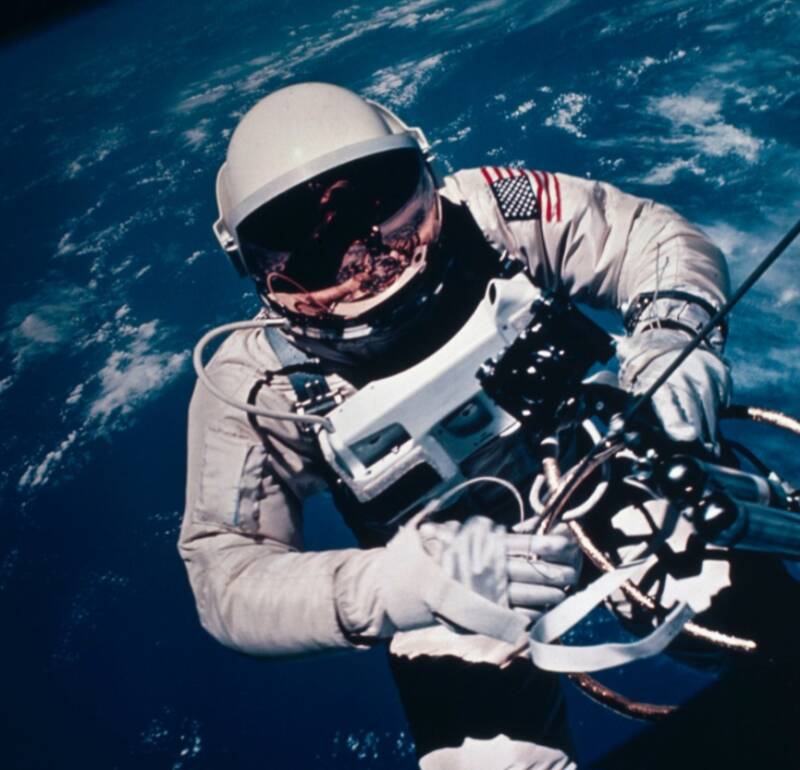
Through ten manned missions between 1965 and 1966, Gemini proved that American astronauts could survive long-duration flights, leave their spacecraft to perform work in the vacuum of space, and successfully find and dock with another vehicle while traveling at 17,500 miles per hour. By the conclusion of the Gemini program in late 1966, the technological momentum had definitively swung toward the United States, clearing the path for the Apollo missions that would ultimately fulfill Kennedy's lunar promise.
Create Your Own Website With Webador